An Hour with Al Quie
This is an audio recording of Al Quie at the 2017 Valley Grove Country Social.
Note: The transcription below was done with AI, so forgive the grammatical and spelling errors. Also, please excuse the beginning of the clip, as we encountered a slight feedback issue at the start, but was corrected at 23 seconds.
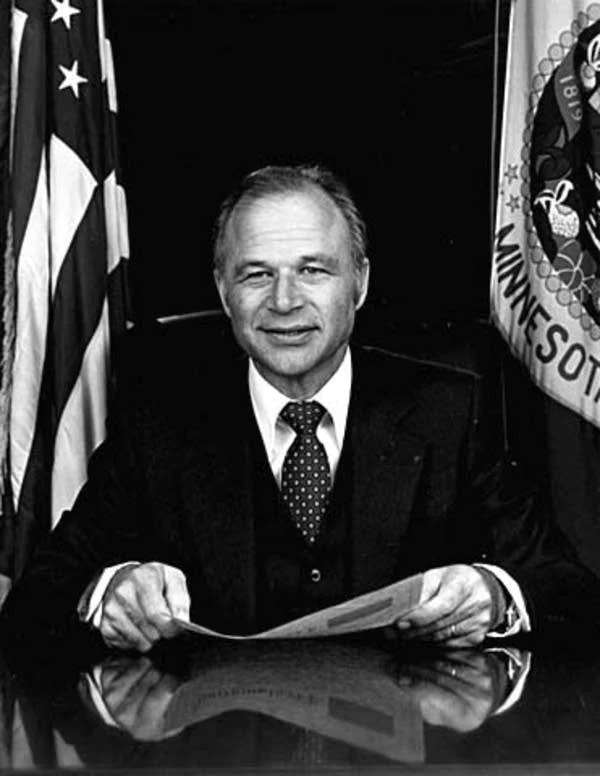
Former MN Governer Al Quie (Died 2023 at 99 years old)
My name is Gary Wagenbach. I'm president of the nonprofit Preservation society at the moment, and I'm a part of a team. A cemetery board is represented outside here, and they take care of the, grounds and the cemetery, per se. Our group, the preservation Society, a nonprofit, has been taking care of the buildings and the 50 acres of restoration land that surrounds, the site.
I've been doing that for the last 17 years, and the history goes much deeper than that. Anyway, welcome. Our hour with al this afternoon. Involves a team effort. Michelle Ratner, one of our fellow board members, is over here, and she is helping us this afternoon. And when we have some time for questions later, she has a mobile, mobile microphone.
And we'd like everyone to hear our question. If you wish to ask a question. And she will be roving, and helping you convey your question a little bit later. We thank John. Hello, rude. Who is up here somewhere? He's a B back here, for helping, Al Cui, come from the Twin Cities and, this afternoon.
So thank you, John. And, we'll get to a roll that Lee score and his helpers played a little bit later in the story this afternoon. For logistics, I'm just going to give a brief introduction. And then, we'll get into stories and questions and explore, Valley Grove aqui, connections to Valley Grove, other layers that you might be interested in.
And there are many layers to al and his relationship to our community, this church and to Minnesota and the larger region and the entire US. As a matter of fact. And to help you with a little agenda, our little strategy this afternoon, I'm kind of thinking of what it might have been like for al when he was a stood between all of and as a retired teacher, I'm fond of using teaching strategies of various sorts.
So I have one for you. And al this afternoon. Each of you in our session this afternoon have some responsibilities. And here's the way it works.
Back at the entrance is a, one page flier that is a compilation of an NPR interview that was done with our, 2013. I guess it was. Yes. And represents a public persona that Al Quy. Yes. That is represented in the media and, in bits of history about Minnesota and the Minnesota government. And well beyond that.
So you may pick up a copy if you have a copy, you know, hold that and use that as part of your assignment for the afternoon and your assignment is to fill in the gaps in the history here. That is the between the lines connections with Valley Grove, the history and the connections run deep. And so al will make remarks, tell some stories.
And if you have questions to help fill in your understanding or our public understanding of Al's connections to Valley Grove. Please participate this afternoon. Just to remind you that al grew up on a farm that's just a couple of miles. Was just a couple of miles east of us here. The farm is still there, of course, but that's where he lived when he was a youth.
And you go down through this page in the history of his engagement and government is kind of outlined there. One, a bit of history that's not on that page is that in 1974 he was considered, I understand, at least briefly, as a vice presidential candidate for the US. I don't know if you want to ask him about that or not, but anyway, that's another little, little known fact hidden in a 1978 became the it was elected the 35th governor of the state of Minnesota.
So that's a role for that sheet. So moving on then.
I would like to just help all become aware of our audience this afternoon. There are a lot of gray hairs out here, I see, and I'm one of those. I have very little. But what I do have is gray. And I see a lot of companions out here in that category. I expect that also anyone over 90 years old in the room, any any folks over 80, raise your hand.
Okay. We've got a couple of candidates up here. So we have some 80s. 80s. I'm I'm still at oh in the back as well. Okay. So we have some friendly old timers here. I wonder who the youngest person is in the room. Anybody under 25? There's a baby back over here. Okay, so there's a newer generation back here as well.
I ask about the age of our participants, this, audience this afternoon because, al has been with us for a long time, and he. His birthday is tomorrow. And before we depart this afternoon, I think it's mandatory that we sing Happy birthday. So save your voice for our closing moments this afternoon.
So you've got your assignment for this afternoon, and. And al has his. He's back in the classroom at Saint Olaf, and we ask you all to come up here and be in our seminar this afternoon and sit in this front chair, and we'll get started.
So let's read about.
About, how's that in the back? You hear me? All right.
A little closer.
Got it. Okay. Think I'm ready to go.
Rachel.
First, I'll be back again.
I won't be horizontal. I expect to be an ashes. My wife's buried out there. It'll be good to see her again. And the fact I think of that every day of my son, it'd be good to see her. But I don't know about those folks who are here. The first times I came out of Allegro Church, my folks, taught me the Holling language.
I think it was because they went to Valley Grove Church quite a few times, and I couldn't understand a word they said.
It had no.
Vested and glory hole. Why are they talking English? Something like they could hear it and they were. It was. So you're still okay? Yeah. If anybody can't hear me in the back, just raise your hand. Unless you don't want to hear me. And then you don't raise a, that that little better for you, In the aisle there.
You held your hand up when I was here once before, too.
And, so.
That's the way it goes. But anyway, that's that's what I remember is that first year. And then as time went on, I realized the feelings that Norwegians head for each other. And because of these surroundings around here, minded people evidently holding the whole Norway. And the horns came here and stayed. So the group and they started a church.
And it wasn't a difficulty for my grandfather, because he was that, what did you say? Four and a half miles for two half miles from here? And, but when his church was only two miles. But there were elders, and he wouldn't.
He wouldn't go.
To any church involved with us. But it took a while to, to forgive dad, because we didn't. They didn't come here for a while because he married a girl from Lang's church. And,
Hard to get over that,
That you'd mix of breeds like that.
And so.
We then started coming back, and then, we all got older and and so forth, but it always had something that stuck at my heart because every Armistice Day, American Legion put a flag right this, to stand right beside his grave because he fought in the Civil War and, just was awesome to me that a young Norwegian would go to war here because he didn't believe in slavery, but he didn't.
He was wounded, and he. And he came back again.
And so, it's.
It's interesting that a person can be have such an indelible impact on his grandson. When he died before I was born. But it they talked about him a lot and, and some of the papers are written about him since, as well. But my thinking of it was play with my toys under the table, listening to my relatives talking with each other was when he, when they talked about the war that he was in and marching against each other with the South and the north, and I couldn't, imagine people doing that and shooting each other.
It was just beyond my comprehension that I was so frightened as I did. And so, changed later. And he joined the Navy Air Corps.
And so,
I could get in it, but it was so. But, this is a place for I also added for your history something that baffled me is that, Nurse Strand decided to build a church so the people could go to nurse straight as well. It was a white church like this. And, evidently somebody from Villa Grove saw the plans.
And before they could get that church built a nursery strand. They built this one right here. We're sitting in.
We're going to get ahead of, I love the, love the, is and, yeah, there's.
A there's one other thing that, about the holy language that was preached my folks taught me about God and the Holy Spirit. And, if you read, Joe Packer's book now knowing God in there, he asks a question, What is God? You usually you couldn't say. People would ask, Who is God? But he said, what is God?
And he answered it himself. He says, God is spirit. And so that's why I realized there was such a moving experience out here, because God was present. And you knew he was present because when the organist would hit certain notes and then the windows would rattle.
I think that was God rattling the windows at us. Sorry.
But speaking of funny, I went to look at that door because the pastor was preaching and he said, oh. By the way, they turned to English after a while here in this church, too. And he said at the end of a sermon, he said, now.
We'll.
Turn to him. 327.
The organist sat there.
And,
Plunked her hands down. Not a song came. So the pastor said, a louder voice. And now we will sing.
Hymn.
327 and then the organist, plunked their fingers down, and no, on. And the pastor tried to talk to the organ pumper back here, and, nothing was happening. So he came down out of the pulpit.
And,
And you see here, it's also used to come right from the sacristy. But they changed it this way, a nurse, too. And so they did it, here too.
And,
And he went over there and,
Opened up the door.
And the.
Organ pumper fell out.
He'd been sleeping.
In there.
With his back and said, Dora, check the door to see if it would sleep easy if somebody opened the door. I mean.
Fall out of somebody open the door. Sure enough.
It got a lid on the platform, and, the, the congregation just roared. But,
I won't tell you which one of you. The organ pumper was a relative of.
You probably talk.
About in family meetings. This is where buddy the. I don't ever tell anybody.
But, the,
I was going to tell you one other one. The one another one about my grandfather who, really loved the church. And he took helped with the pastor all the time. And, they used to have Christianity in this, call as well. And his job was to take, the pastor back to, I think his name was Ruth Watson.
And, back to Christianity again. And so he was driving along in his buggy, horse and buggy. And when he got to Northfield, just north of Northfield, the horse pulled him in front of the brewery.
He had walked the horse from the brewery and had been used there.
And he was so embarrassed that the.
Pastor would have thought he frequented that place.
Because the cookies were teetotalers.
I thought that was another, funny.
Funny one. The,
Interesting thing was, was elementary school.
And we went to nursery and part of the time and sometime to, the hookey school, which is just a mile west of us. But, my brother and I didn't get along very well with the other students, and, else, I don't know if you remember. The hell.
Am.
My dad took us out of, of the school, put us in and nurse our. And it was, And what I'm leading to, that's when the Spirit of God became one. Was there from that time, I never doubted God since, I was getting ready to go to school and my mother. And then in the winter time, and my mother had.
And sort of the end of elastic that was through your sleeves, you'll remember. Remember those? And dad was outside getting the horses hooked up to the sleigh, and he had made a covered sleigh on top of the wagon box. He'd run plywood up for a flat on the top and they closed the door behind. Everything was enclosed. Darkness could be in there besides some isinglass that they used to put on barley for a model T Ford cars.
And, so, I kind of got around my sister so my mother couldn't see that my hands weren't in my mittens. And I got out the door with, her calling me back, and.
I.
Hung around behind my sister. So when we got on the sleigh, dad didn't notice it either. And I knew that getting out of school, he would notice that he give me a hard time. And we had a going up. There wasn't any difficulty because we had those horse hide robes and I kept my hands under there. So how in the world am I going to get that?
Because yeah, I used to practice as a little kid to fold my hands with my eyes closed, see if I can get them together. I was that uncoordinated. And, and so I prayed to God that my hands would go in the mittens. And so I took with my right hand the my left hand stuck my thumb in the cuff.
And then with the other hand, I just pushed it right in. I was so surprised. Now I have to do it with my left hand, which you are coordinated with your left hand. Very well. And I reached over and took out the cuff of my right mitten all the time. Take. And then I pull my right hand back, and it went right in, and the thumb went into the thumb hole and I shouted to myself, nobody here us have a shoulder, so there is a God.
And a bright light burst in that sleigh. And even today, as I look towards dad's back with the lions in his hand and my two sisters sitting beside me is just as though I was looking at a photograph. Isn't that amazing? And that's what God did did to me out there. So, that beginning is just was so meaningful for all, of of my life.
The, the other thing I wanted to mention is that, horses always fascinated me. And so I would. And every chance I took when we came to Valley Grove to look at the horses and the horse were in and in the sling time. And then there were more horses here. And I could look at all those horses.
I remember walking in the barn and looking at the horses, and so not. And I couldn't figure out some three people. One were the team know there was a horse, took the harness off and, you know, hung it on a hook. Waller and church. The others lift the harnesses, and had them tied up in there. And that was, fascinating to me.
And when it rained, a lot of them were able to squeeze their buggy underneath the overhang and into the into the barn roll. And then I go in front of the horses and, talk to them, because at home, beginning at three years old, I began studying horses as they communicated with each other and saw that there was a relationship between them that stayed with me all this time.
And, that's another reason why I have confidence in God with the spirit is, I can communicate with the horses.
Oh, my son, I went down to Missouri a couple weeks ago and got a couple of mules and one for John Hell Road and, one for himself. And he got bucked off his his mule for his wife's mule and broke some bonds and his shoulder. So he's got a sling in his hand. So that's the only one, who's my son who is here?
And he recognize him, but his arm is in a sling.
And you.
Can just say hello to him and say how mule riding.
And. And, so,
That that whole business of communicating. Yesterday, I was out there at his place, by Rockford. And before I left, we were fixing some droves. I said I needed three hands in order to do that, and, I said I got to go over and say goodbye to that mule. The one to buck them off. And I didn't know what in the world to do because you, with me.
But I walked out there and, he hung back a little bit. Then he came over towards me, and I gave him a sugarloaf. And the horse. The horse? The one horse of Dan's a sugarloaf, too. And then I turned to walk away, and he walked through the gate, following me. And it is so good to feel that he had forgiven me.
Oh, I that's the kind of a person you got speaking to you. You're glad when somebody from the restaurant forgives you.
But,
But, here is. I'm so glad.
Because.
I believe you forgave me.
So the last thing I was going to say. And then we opened up to questions as, my dad for two years went to Faribault and soul Automobiles. We live there. I don't remember that time at all. But, when he came here to church one Sunday and it was a Willis night automobile, and he drove in like you would have, you had a team of horses to the Hitching Bowl, and, he just turned as well as night into that instead of parallel parking.
And other people came and talked to him about that and wanted to see and, and and that was night. Had side curtains on it, you know, that's as long ago.
As it was.
And I can imagine, how proud dad was of that and, how it filled the heart of the valley girl. Rosa. Some have a a car, a car like that with a car. So that's that's my ancient history that, that I have lived through. If you want to ask anything that, people remember from about 90 years ago, tomorrow I'll be 94.
So I don't remember too much. Before I was four.
But I remember I was three when I, began visiting the horses and talking with them and standing in front of them and watch how they communicate with each other. And I communicate that way with was by itself and other, responded to, okay. The, that's that's it for memories here. You can ask me any question that you want to if I knowing it.
Oh here's right back there the cowboy.
Oh come on, hang on. I'm coming.
Oh, Karen. Hang on.
When did your family change its name from the Norwegian spelling CVI? We. And why?
From CVI to q u r e the King of Norway told them to.
When? When Norway.
Became independent.
And then the king.
Told everybody get their names together. But they had two different, different ones. And so q u I said, from now on there's going to be a CVI. And so, my dad, being a good Norwegian, changed it to CVI. When my grandfather came over here, it was Q u a and he went to see his dad and said, I think you ought to change yours to CVI.
And so out there in the graves there was this CVI, and they didn't. I think one of the reasons why dad didn't is because, heavy is so much like Krieger.
But nobody was looking at your faces. You don't know what Krieger is in Norwegian. It means a pregnant heifer.
And what? Oh. I'm wondering, governor, so when you talk about the barn, when you used to talk to the horses and, and watch them communicate, the location of that is that kind of where all the out in the parking lot, where all the cars are today? I was kind of curious about I know I had seen a picture or kind of a.
You see the picture where it is, it's pretty close. It was pretty close. It probably set back a little bit. The barn did, and I might have been a little bit longer, a little deeper. How many horses.
Do you think it fit?
Oh, I know quite a few. The. But not too many Norwegians come to church early.
So that a park has.
Any more questions?
They had some box. There's some double stalls. Number of single stalls, and then a number of horses, a better like each other pretty well, because they're all just a string of tying in there, and you can squeeze more in that way. Yeah.
Oh. Of course there are.
I Jo Joe a car, but I found a place that, rented horse rides just west of Saddle, and, went out there and rented their horses to, to, ride because, I fell in love with a beautiful girl from Annapolis, and she had never ridden a horse before. I figured I better check if she can handle a horse or I before I asked her to marry me.
Yes. I was sorry that you were, you know.
Over, single sort of buddies around, old maid. Is that a true story?
That's a true story.
Why don't you wait? You said a little bit more about it.
Yeah, I did it upside down.
Just wanted to show off. But it was before I met Gretchen. Many people. See, I did that to show off to Gretchen, but I didn't know her at that time. Well, I came to the turn it upside down, and then I flew her on August 3rd. Melvin. And then around. Man, come back again and turn it right side up.
And, the reason why I did it upside down is there are no numbers on the bottom.
Of an airplane. No, on the top.
I say on the top of the airplane.
It's said all of it.
Yeah, I did a few other things.
There are playing there too, that I probably shouldn't talk about that.
Yeah, I'm.
I got to tell you. Hey, Beatrice here.
I remember the time you.
Were running for governor.
And you were in this area, and you wanted to make a video with a horse. You called us and rode one of our horses. I think it was over at Selma Jacobson.
This place? Oh, yeah.
What year that was. But my other question is, I know you're such a great horseman and you relate to horses. When did you train your last horse?
When did I do? What was my last horse?
When did you train your last horse?
Oh, the one that I'm riding now, I train him. But that was quite a few years ago. The that I got him done riding. Where are you? Yeah. Oh, all of the old is a relative. Of my horse, Missouri Fox Trotter. Do you think it was. Oh, I'm.
Family. So how many years did you had him? Three years.
Well, I had my horse. What?
Yeah. Okay. I, had my. And probably if. Well, is he, I've had him at least seven years. Yeah, yeah, we do, we do a lot of things together. Yes.
Governor. When you look back on your legacy, what do you think is your single greatest accomplishment that you did up in Saint Paul?
What do you. What? So what do you get Saint Paul in there,
Oh, just, as governor.
What what do you consider your single greatest accomplishment?
Oh, okay. It, I, frankly, I enjoyed when I was governor the most because of it. Just one of us. And,
And and because I was able what I like to do is to look at how do you solve the problem, does that with horses and everything. So you look at the legislature. How do you solve the problem? The we didn't have enough money and the Republicans had cut taxes. And, that's all work that they'd say they see all the time.
And I knew we had to have more money. And so I developed what we'd call the indexing of the income tax. And let me give it to you. So.
And, and, you got some down there, and.
It's this way with inflation, people move up in the income tax brackets, so their purchasing power is really less because it got a higher tax on them. And when that doesn't happen to those who are at the highest bracket, that's why I call it indexing the income tax brackets. So as inflation went up and then the bracket they moved up and the the bracket moved up or widened so they wouldn't have to take any more of their purchasing power away.
And then those over the 35%, you know, they're wealthy people. They might as well do more. And it was so tough to get DFL to understand that it, it was tough at first to get Republicans to do it, but I got them convinced. But but but when when the, moment came for the DFL and, then they still didn't go along and I told them I'm going to veto the whole blame tax bill if you don't do it.
And they then called it back and passed it and in the house. And, here's the interesting thing. When that went through.
DFL head my office smiling and shaking hands.
There, I thought you could do it.
And,
Last year when I went to the Capitol, and then I, met people in the hall who had been there back then, and it was interesting, the ones who lined up the most for my autograph were DFL.
All right. We have.
Okay. You got somebody.
Back there, I do somebody who's maybe even a couple years older than you, governor Clay.
Well, I look at.
Now, first thing is, can you hear me?
Can you hear.
Can you hear me?
I could hear you.
Okay. All right.
What's your name?
I thank you for the hundredth birthday wishes. I'm a little.
Sick. Yeah.
You're 100 birthday. Yeah.
To be here. But not to surprise I, because I have ancestors and no way I one who lived a long, long time. One and well documented as having been born and 1653 and died in 1757. Well, and he never saw a doctor in his life. But I think it was all, crowd and all that, fresh, unpolluted air.
And speaking of wonderful air and beautiful place, this is one of the loveliest places I can think of. My father introduced me to this as a small child growing up in Ballard's field, and, we came out here. It was his favorite place on earth. I thank him, and I so congratulations to the all the committee and, all the people worked so hard over this years.
Their work is much appreciated. Thank you.
For that.
Thank you. Yeah. Thank you.
Her name is Brynn Held. Roseburg, and she's from Northfield. And she was 100 on August 26th.
You can tell they all of us for Christmas.
Well, there was a.
Lot of good pushes back in that quarter. Must have been huddling.
Governor, you, have talked a little bit about the barn on the property and also the side buildings up here in the front of the church. Yeah, on the stone church on the east side of the building. And you can see the, the cement work's been done. It appears that there had been some kind of a structure hanging off the east side of the stone church.
Do you have recollection of what that was? What you said had. And how was that stone church used during the time you were growing up with this being the primary, place of worship?
Yeah, I remember first I was back after it was gone. I could hardly believe my eyes. It was a woodshed. We were two kids. No, I guess I don't need it anymore.
Do you ever take it off behind work?
Yeah. Yeah. Yeah. Again.
Again. I'm curious about, you talked about the Holy Spirit in your life. Where did he help you or didn't help you while you were in politics?
The Holy Spirit helped while I was in politics because. The Holy Spirit doesn't care about political parties. And I just to I tell you, one story to show the one guy I didn't get along with as well, at all. And,
One day he came and sat beside me and I thought to myself, I know God wants me to talk to him, but we were sitting in the front seats of the chamber so he could pay full attention to the speaker, but I forgot what the everything about the speaker at that time, with him sitting there and, he turned to me and he said, well, we are to get together and pray together sometime.
And, we did. We picked two more people and we prayed every, every time. Our goal was when the first quorum call began. The fervor to get there take about a half an hour. We'd go over that little chapel between the house and the so that we sit there and pray together. And so I started talking with other members of Congress about, and, the we came together and some of them were really ultra liberal too.
And also interesting on one with Jim O'Hara. I had never could get through to him. Democrat from Michigan. And one day I said to him, let's go over and listen to the speaker. It was on, nonmetallic mine safety legislation important to the northern, part of the United States. And we did. And as we walked back again, we talked a little bit.
And he said, you pray with some guys, don't you? Knees? I said, yes, he said, come into my office, let's pray together. And the legislation, which had never had a chance before, passed. And when the Wall Street Journal wrote article, they said that legislation passed because of a prayer. And so sometimes it took a long time before the Spirit of God entered us as we hoped for a the same spirit that I expected in Valley Girl.
But the language was wrong.
And in Congress the language was wrong with the Democrats. But then when you came together with the Spirit of God and look for what's best for the people, and then you don't follow your party necessarily, you do what's right. And that's how I got got to be out there. So it was a marvelous experience.
Right over here.
I want to talk about the greatest moments I had was the Promise Keepers during lunch, 60,000 women.
And guess who was next to me?
Your grandson is there, right?
We are literally moving through.
We did our lunch together and I said, you know that I love your breath. That's because of what happened with God's Spirit. First with, the, wholesome.
Yeah.
The senator in Iowa changed, hearts. Really? Were. Yeah, I totally agree, I love it.
Yeah. God, it God has worked in some marvelous ways. And the prison ministry is surely, surely true. I'll be back with, a little prison again. Well, a week and a half ago, and, these guys. I haven't been up there for quite a while. They didn't know me. They'd heard about me. And as we talked, it was amazing.
The change they caught came over there.
Yeah.
They they followed me out to the grounds and everything like that. And they said, hey, you belong in there. I'm not supposed.
To be out here. Yeah. Yeah.
You got you got your. Well, that's thick. Isn't a microphone.
No.
How do you understand your role? No.
Your your life. Your role as elder statesman.
Yeah.
All aspects of your life for the future.
I don't really know. You just wait on the Lord.
And so.
I go to belong to, or, Folkestone and Wayzata, which is a, assisted living. Please, grandson. I live there before him. And, a couple of a woman there as an example. There's read me out. They didn't like my religiosity and the fact that I was a Republican, and I like that. They really chewed me up and and I prayed about it.
And, both of them.
Know the times have come over to me. God has sent them over to me. And we talk and we become friends. And so what it is, is to wait on the Lord right now to serve in Congress, to somebody come and stand beside the rose sitting. And I look up, somebody who had never talked to me before because I was a Republican.
There's a come here. Is that, and we sit and talked about the Lord and, and so what I, what I say is wait on the Lord, because if you got the plan of the Lord, you better shape up and help me. You know, it doesn't work that way, but it's just like looking at horses.
I turn my horse, Spanish Bull, and I had a out into the paddock after a long and difficult ride and, taught them to follow me, you know, when I didn't have a halter on. So open the gate, let them go. And he looked out and saw the other horses, his buddies out in the pasture, and he hustle over towards them.
He stopped to look back at them. I look back at them and then he came back to me as if to say, I'd sooner be with you. See, you know how it pleases God.
When somebody says, I'd sooner be with you. Because we can communicate together not only in words, but in spirit as well. And, you know, there are people like that it if something is between you. So, you know, I'll tell you, it goes back. I'll tell you about fun. Ernie Flanders, dad and Gretchen, we're really close because of the art background.
And when I saw Bob flying out here.
Then there was a spirit between us.
Any other questions?
I wanted to ask a little bit more about your. Your dad and I noticed in the 75th celebration anniversary of the Rice County Soil and Water Conservation District, and the big spread came out in the Northfield News just a few weeks ago. There's a photograph of your dad and other supervisors, that, helped found this salt water conservation District 75 years ago, 1942.
I guess that would be. And then later, I understand that you served on the Southern Water Conservation District supervisor board. For a while, as have I. I just finished a year ago, and I feel a lineage through you, your family in that local unit of government and I wondered if you would comment on the influence your dad, your estimated influence that your dad had in and, various ways on your, perspectives on how to care for our farm or the local unit of government that we call the soil water Conservation District.
Yeah, I, I read that and saw the pictures in there and good picture of him.
Yeah, yeah. And,
You said.
Number too.
Okay. Yeah. Yeah. There's a dad. Dad. Especially when I got to high school he took me with him to hear what, what I would call conservation.
Ambassadors or conservation. Ministers, evangelists or something like that. So. And so I could hear them talk about it. So when I became a farmer, I then expanded what I heard them say. And, and Dad and dad began contouring the farm and so forth, and so and gradually I got married and, and, took over the farming and then contoured the whole thing.
And, I find it interesting, president. I mean, the, governor Dayton said you ought to have 50ft on each side of a waterway. And so when I put it in the grass waterways, that's what I did. I put a grass 50ft on each side. And, this is me, this area and all the soil and and a good rainstorm.
It used to be there'd be a big delta, runoff. We'd go down the ditch and make it level with the road, and never again did that ever happen. It was stopped, slowed, so went back down to New York state, stayed on the farm. And so, and, we we had the, the, part of the farm that's closest to where John Hill Road, lives.
And that's pretty plain flat. The glacier had stopped before that. So that's where the contouring needed. And, then later on the, the, the more of the that was a law. So it was protected. No. And there was a huge rock there that it was pretty hard to look over standing beside it. And I got that thing buried.
And to tell you how big it was when the big bulldozer dug that hole alongside and order to topple it into, you couldn't see the bulldozer down in the hole is that big? And so.
I was really sold by, the missions for that kind of soil conservation. Conservation. I remember one time, one of the two, this little brothers said they look from the hill, and they said the the stripes in your pasture. And I said, that's only June grass that had grown there. So I put nitrogen in. And that's what you see.
The lime spreader, marks where it because I follow the wheel tracks as a little place. So there wasn't. And then I was reading a book by Louis Bromfield, and I heard that roots for trefoil put righteous into the soil. And so what I did was just saw, birds of trefoil. And to the south part of the, the farm or out of the pasture, and then rotated the sheep pasture so that that would have a chance to grow.
And and then those beautiful buds would grow up and it was grow along and reproduce itself. So that's, that's just some things that you do. But in case you want to make money doing all these things, increased by corn production from 68 versus the acre to 165 or 60 acre. Pretty good.
Increase the milk production of the cows. There's a huge amount. That's why I didn't go to goats.
You.
Know, I'm just about done with our our with you. Every year we host our, candlelight Christmas Eve service, and I was wondering what Christmas Eve was like when you were coming to church here.
So it said again.
Every year we host our candlelight Christmas Eve service here at Bailey Grove. And I was wondering what Christmas Eve was like when you came to church here.
Well, I sat there hoping that they'd play the key to make the windows rattle.
But,
It's beautifully decorated. It was beautifully decorated. Yeah. And, there was some. There's something about. I heard there's different here than Nurse Tran. Sorry. A nurse friend. And that is.
When they built that old stone church, it was a hauling farmer who came over with his wagon and planks.
For some up the side. And the father went over that tuba for us. So you can turn it over the easiest. But he brought it over here and there, piled limestone rock on that wagon, and he drove it up here, and they used it to build the church way back when the, was. And that wasn't even a relative had told me about a.
Yeah. I think it's time to get your singing voices ready. Oh, singing a little happy birthday time. I am not going to lead. Happy birthday. I don't think.
Should we all rise and sing Happy Birthday to Al?
“Happy Birthday is sung”
I'm amazed you could stand in that place.
Yeah, well, thank you all for coming. There's tea and coffee and socializing time outdoors or in the stone church. If you wish to visit a a day out for a moment.
Shake his hand. Please do it for the family. How do you let your brother merry go round? Oh, yeah. And you got taller. Oh, yeah.