Valley Grove Alter Painting by Kristin Anderson
Written by Kristin Anderson Art Department Augsburg College for the 2016 VG Newsletter
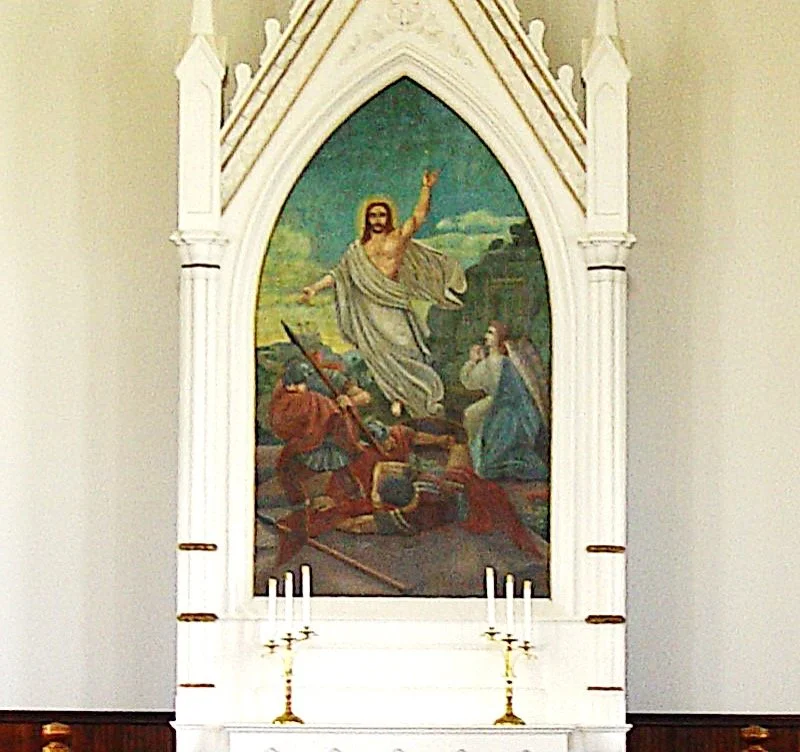
The Valley Grove altar painting displayed in the 1894 church, like most other altar paintings, is a copy of a famous original. In this case, the resurrection scene was a reproduction of the altar painting at Marienwerder Cathedral at Kwidzyn, Poland. The artist, Bernhard Plockhorst (1825-1907) was trained in Munich and Paris and later became a professor in Leipzig and Berlin. He specialized in religious subjects, creating the originals of a number of well-known altar paintings such as The Good Shepherd, Jesus with Peter on the Sea of Galilee, and Jesus with the Disciples on the Road to Emmaus. These popular images were widely copied by artists in Scandinavia, Germany, and America for local church congregations that wanted an image or statue above the altar. Most of these artists had never seen the originals. They relied instead on small black-and-white reproductions from which to create their enlarged and full color oil paintings for the local church altars. In the upper Midwest, such artists as Herbjørn Gausta, Sarah Kirkeberg Raugland, Arne Berger, Andreas Pede, and August Klagstad produced large numbers of these altar paintings for Norwegian-American Lutheran churches. The Valley Grove altar painting was not painted by one of the Minneapolisbased professionals listed above. The painting looks like the work of a self-trained “people’s artist” — someone working in the fine arts without the benefit of fine arts training. There is no visible signature, but the church records identify the artist as Trond Eltun. His name appears in a little note indicating that the congregation accepted the painting on the condition that Eltun make some changes recommended by Pastor Quammen. It is not clear what those alterations were. One of two men — grandfather and grandson -- may have been the Valley Grove artist. First (and most likely), a famous hardanger fiddler named Trond Eltun (1823-1899) emigrated to Minnesota from Vang in Valdres, Norway in 1876. In the 1880 census, he and his son John were living in Dennison. Eltun traveled around the upper Midwest, performing for audiences in Norwegian-American communities, and the Rice-Goodhue Norwegian-American settlement seems to have been his home base. He had relatives in Dennison and in the Valley Grove church. Eltun died in Hanley Falls and is buried near relatives at Wang church cemetery near Maynard in Renville County. His grandson, also named Trond Eltun (1871-1913), emigrated about the time the painting was created. He was quite young at the time, and there is no indication in his later life that he was an artist. He worked as a physician and died in Velva, North Dakota.